
Mayan symbols tattoo meanings and respectful design ideas
A mayan symbols tattoo can be visually powerful, but responsible planning starts with the right terminology. Museums and scholars usually use Maya for the people, culture, art, and civilization, while Mayan most often refers to the family of languages. People still search for “mayan symbols tattoo,” so this guide keeps the search phrase while explaining the more accurate cultural term. The safest approach is not to copy a random glyph chart. First decide whether you want a readable date, a calendar day sign, a numeral pattern, or a broader Maya-inspired motif. Then document what it means, what it does not mean, and where the reference came from.
For more articles on symbolism, placement, and tattoo interpretation, explore our tattoo culture section.
Why Maya symbols need more care than ordinary decorative motifs
Maya visual culture is not a simple alphabet of icons. The Smithsonian National Museum of the American Indian describes Maya writing as a hieroglyphic system that combines whole-word signs and syllabic signs. That distinction matters for tattoo planning. A glyph does not function like a modern emoji, and a complete inscription may involve sound, grammar, names, dates, titles, and historical context.
The Classic period, commonly dated to about 250–900 CE, is often associated with major Maya achievements in architecture, carved monuments, painted ceramics, astronomy, calendrical systems, and dynastic inscriptions. Maya culture, however, is not only ancient history. Maya communities continue to live across parts of Mexico, Guatemala, Belize, Honduras, and El Salvador, and contemporary traditions are not museum props. A tattoo can respectfully draw from historical art, but it should not treat living cultures as anonymous decoration.
A useful Maya-inspired tattoo brief should answer three questions: what is the symbol’s source, what meaning is reasonably supported, and what cultural or sacred context might make the design sensitive. If the only answer is “I found it on a tattoo flash page,” the design needs more research before it becomes permanent.
Common Maya symbol categories used in tattoo design
The phrase “Mayan symbols” is broad. In tattoo searches, it often mixes authentic Maya glyphs, calendar signs, archaeological motifs, modern New Age graphics, Aztec imagery, and artist-made patterns. Separating these categories helps prevent inaccurate designs.
| Symbol category | What it can mean | Design caution |
|---|---|---|
| Glyph blocks | Writing, names, titles, places, dates, or short phrases when correctly composed | Do not assume one block equals one simple word; readable glyphs need epigraphic accuracy. |
| Calendar day signs | A specific day in a sacred 260-day count, often chosen for birth dates or personal meaning | Different communities and scholarly systems may use different names or spellings. |
| Maya numerals | Dot, bar, and shell-like zero forms used in number and date notation | Numerals are elegant, but they should be checked if combined with calendar dates. |
| Sun, maize, rain, serpent, and jaguar motifs | Broader themes such as time, agriculture, rulership, power, water, and transformation | These are cultural themes, not one-size-fits-all meanings. |
| Internet “Mayan” symbols | Often modern spiritual graphics, fantasy designs, or mixed Mesoamerican imagery | Verify provenance before presenting them as ancient Maya symbols. |
Calendar symbols are popular, but they are not generic zodiac signs
Many people are drawn to Maya calendar tattoos because they feel personal. The best-known options are usually connected to the 260-day sacred count and the 365-day solar or agricultural calendar. The Smithsonian’s Living Maya Time project explains that Maya calendar systems are connected to cycles of time, agriculture, ceremony, and community life, not simply personality labels.
A birth-date design can be meaningful when it is carefully calculated and checked. The result may include a day number, a day sign, and sometimes additional calendar information. A common mistake is to accept a modern online conversion without review, then ask a tattooer to copy a low-resolution glyph. If the tattoo is meant to represent a real date, the spelling, number, glyph style, and layout all need attention.
Ajaw, k’in, and sun-related imagery
Ajaw, often written Ahau in older or Yucatec-based spellings, is widely recognized as a day sign and is associated with lordship or rulership in Maya studies. K’in is associated with sun and day. These signs are appealing in tattoo design because they connect light, time, authority, and cyclical renewal. Still, they should not be described as a universal “Mayan sun symbol” without context. A calendar sign, a word glyph, and a decorative sun motif are related possibilities, not interchangeable objects.
Dot, bar, and shell number designs
Maya numerals are among the clearest options for minimalist tattoos. Dots represent ones, bars represent fives, and a shell-like sign is commonly used for zero in calendrical notation. Numeral tattoos can work well as bands, vertical stacks, or small wrist and ankle pieces. The main limitation is readability: someone unfamiliar with Maya notation may see a pattern before they see a number, so placement and explanation matter.
Motifs that work well in Maya-inspired tattoos
Not every tattoo needs to be a literal inscription. Some of the strongest designs use Maya visual principles—stepped forms, framed glyph blocks, balanced symmetry, carved-stone texture, and dense linework—without pretending to translate a sentence. This approach is especially useful if you admire the art but do not have a confirmed glyph reading.
Maize and the cycle of life
Maize is central to many Mesoamerican traditions, including Maya stories, agriculture, and identity. In tattoo design, maize imagery can suggest nourishment, ancestry, growth, and continuity. It may be rendered as a plant, a stylized ear of corn, or a figure inspired by ancient art. Because maize has deep cultural and spiritual importance, it deserves more than a generic “tribal” treatment.
Jaguar symbolism
The jaguar appears frequently in Mesoamerican art and is often connected with power, night, rulership, and the boundary between worlds. As a tattoo motif, it can support large compositions on the chest, back, thigh, or sleeve. A historically aware design should avoid making every jaguar automatically “Mayan.” Ask whether the reference image comes from a Maya vessel, monument, mural, or codex-style source, or whether it is a modern fantasy cat with geometric details.
Feathered serpent imagery
Feathered serpent imagery is widespread in Mesoamerica and appears in different forms across regions and periods. For Maya-inspired tattoos, people often think of Kukulcán, especially because of Chichén Itzá. The design can communicate movement, wind, power, and transformation, but it is also one of the easiest motifs to mix inaccurately with Aztec or generic “ancient warrior” imagery. If cultural accuracy matters, build the design from a specific Maya-region reference rather than a blended internet image.
What to avoid when choosing a Mayan symbols tattoo
The biggest problem with many “Mayan tattoo” designs is not style; it is false certainty. A tattoo caption may claim that a glyph means “strength,” “warrior,” “protection,” or “eternal love,” but those meanings are often unsupported. Maya writing is complex enough that invented translations can look plausible to non-specialists. A visually convincing glyph can still be unreadable, misspelled, or unrelated to the claimed meaning. See also: tattoo care.
- Avoid copying sacred or funerary imagery without context. Monumental inscriptions, deity scenes, and burial objects may carry meanings that are not suitable for casual decoration.
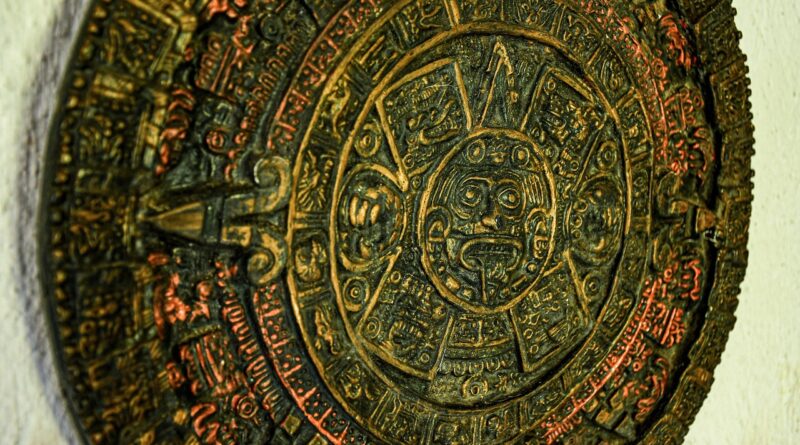
- Avoid the Aztec calendar stone if you want a Maya design. The famous circular Sun Stone is Mexica/Aztec, not Maya, even though it is often mislabeled in tattoo search results.
- Avoid “Hunab Ku” claims without verification. Many graphics sold as ancient Mayan cosmic symbols are modern popular designs or heavily reinterpreted symbols.
- Avoid random glyph strings. A row of glyph-looking blocks may be decorative, but it should not be presented as a real Maya sentence unless it has been checked.
- Avoid using living cultural identity as costume. If the design references a community, ceremony, or language, treat it as more than an aesthetic theme.
How to brief your tattoo artist
A clear brief helps the artist create a piece that is both attractive and defensible. Start by deciding which type of design you want: an accurate glyph, a calendar-based tattoo, a symbolic motif, or a Maya-inspired ornamental composition. Then collect references from museum collections, educational resources, archaeology publications, or reputable books rather than tattoo-only image boards.
If you want a readable glyph or date, bring the artist a clean reference and a note explaining the source. Ask whether the artist can preserve the internal proportions of the glyph block. Maya signs often depend on small details, and over-simplifying them can change the look from inscription to decoration. If the tattooer works in blackwork, fine line, dotwork, or geometric styles, discuss how much adaptation is acceptable before the symbol becomes unrecognizable.
For larger pieces, consider combining a central motif with supporting pattern instead of filling the whole tattoo with unverified glyphs. A jaguar with stepped architectural framing, a maize plant with numeral accents, or a sun-related day sign inside a carved-stone border can feel connected to Maya art without claiming a false translation. This is often a better solution than forcing a long phrase into a writing system you cannot confidently read.
Placement and style ideas that preserve meaning
Small tattoos work best with simple forms: numerals, a single calendar sign, or a clean glyph-inspired block. Good placements include the inner forearm, upper arm, shoulder blade, ankle, or behind the ear, depending on the detail level. If the design includes small internal marks, choose a size large enough to age well. Tiny glyphs can blur faster than bold symbols.
Medium tattoos can use framed day signs, paired numerals, or sun-and-maize compositions. These work well on the forearm, calf, upper arm, or chest. For a stronger archaeological feel, artists may use carved-stone shading, weathered edges, or relief-like black and gray. For a more contemporary look, the same symbol can be drawn with clean negative space and restrained geometry.
Large tattoos allow more storytelling. A sleeve or back piece can include a jaguar, serpent, temple steps, calendar elements, and textured borders. The risk is overloading the tattoo with mixed references. A focused design usually looks more sophisticated: one primary symbol, one supporting motif, and a limited pattern system are enough.
Frequently asked questions
Is “Mayan symbols tattoo” the right phrase?
It is a common search phrase, but “Maya symbols” is usually more accurate when discussing culture, art, people, or civilization. “Mayan” is most often used for the language family. A good article or tattoo brief can acknowledge the search phrase while using accurate terminology in the explanation.
Can I get my name written in Maya glyphs?
Possibly, but it is not as simple as matching letters to an alphabet. Maya writing uses signs for syllables and whole words, and name rendering depends on sound. If you want a name tattoo, treat it like a specialist translation project, not a font conversion.
Are Maya calendar tattoos safe to personalize?
They can be personal and respectful if the date is calculated carefully and the glyphs are checked. Do not rely only on a decorative chart. Save the source, verify the day sign and number, and make sure the artist can reproduce the form clearly.
What is the safest Maya-inspired tattoo idea?
The safest option is usually a clearly sourced numeral, a single verified calendar sign, or an art-inspired motif that does not claim to be a translation. If you cannot confirm a glyph’s meaning, describe the tattoo as inspired by Maya art rather than as an authentic inscription.
How can I avoid cultural appropriation?
Start with research, be honest about what you know, avoid sacred or community-specific imagery you do not understand, and do not present a design as ancestral or spiritual authority if it is not part of your own background. Respect also means being willing to simplify, change, or abandon a design when the context is uncertain.
Final thoughts
A Mayan symbols tattoo has the most value when it balances visual impact with accuracy. Maya glyphs, calendar signs, numerals, and motifs offer rich design possibilities, but they are not generic clip art. Choose a traceable source, use careful wording, and work with an artist who respects the difference between inspiration and invention. The result will be a tattoo that looks intentional, ages better, and carries a meaning you can explain with confidence.